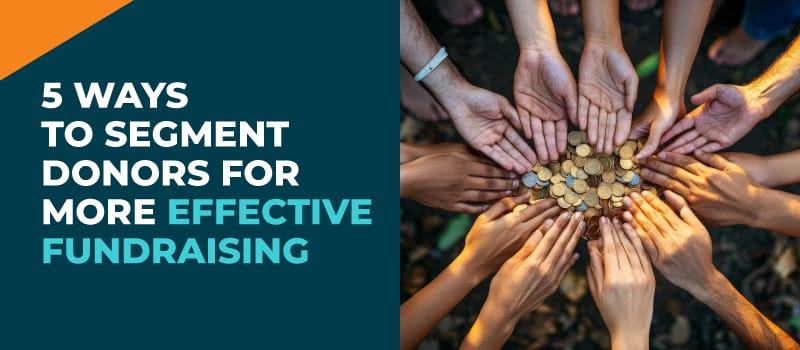
In today’s fundraising landscape, personalization is critical to donor engagement. Your nonprofit’s supporters want to feel like valued members of your community who are integral to furthering your mission—not like ATMs with legs!
Donor segmentation, or the process of grouping supporters based on shared characteristics, is a helpful starting point for conducting personalized fundraising at scale. Effective segmentation is grounded in donor analytics, which DonorSearch defines as “collecting, organizing, interpreting, and drawing useful conclusions from information on your nonprofit’s supporters…so you can better plan and execute various fundraising efforts for your organization.”
To help you get started, this guide will cover five of the best ways your nonprofit can use donor analytics to segment supporters for various fundraising activities. Let’s dive in!
1. Based on Demographics
Demographic donor data is essentially background information that tells you basic details about your supporters. Useful data points that fall into this category include donors’:
- Age
- Gender
- Location
- Marital and family status
- Employment
- Wealth
This information can help you narrow down the best targets for outreach about specific fundraising initiatives. For example, you might use location data to identify supporters who live near the venue where you’re hosting an in-person fundraising event and send invitations to them. Or, you could use employment information to identify donors who work for companies that run corporate philanthropy programs (matching gifts, volunteer grants, payroll donations, etc.) and market those giving opportunities to the supporters who could take advantage of them.
Although demographic data gives general insights into your supporters, keep in mind that it doesn’t fully encompass who they are as individuals. Relying too heavily on this type of information can lead to stereotyping that turns donors away from your organization instead of welcoming them in.
2. Based on Psychographics
One solution to the problem of over-reliance on donor demographics is to also analyze psychographic data, which provides deeper insights into why supporters do what they do. Information in this category that can be useful for segmentation includes:
- Hobbies
- Interests
- Values
- Lifestyles
- Motivations for supporting your mission
These data points allow you to add depth to targeted fundraising appeals. Returning to the in-person event invite example, if the event you were planning was a 5K, you might prioritize reaching out to supporters who live near the venue and are physically active in their free time. But if you were holding an auction instead, you could move nearby donors who enjoy shopping or activities that align with your big-ticket auction prizes (such as traveling or going to concerts) to the top of your invite list.
Certain types of fundraising organizations also see particular success from segmenting donors based on giving motivations. For instance, many universities group supporters according to their relationship with the institution (alumni, parents, friends of the university, etc.) so they can create unique engagement strategies for each segment that align with their specific reasons for giving. Grateful patient fundraising programs at hospitals and other healthcare organizations rely on this type of segmentation as well.
3. Based on Giving History
Giving history encompasses a supporter’s past monetary contributions to your nonprofit, which can help you identify behavior patterns to build on for your next donation request. Here are some metrics to track for each of your donors in this section:
- Average gift amount
- Donation frequency
- Date of last gift (aka recency of giving)
- Preferred contribution channel
- Lifetime value (i.e., how much donors have contributed and/or will contribute during their entire journey with your organization)
Knowing this information helps you ask each supporter to give just the right amount so you avoid overwhelming or offending them while also minimizing the risk of leaving money on the table. This balance is critical regardless of whether you’re promoting your monthly giving program to small-dollar donors or filling in a capital campaign gift range chart with major contributions.
4. Based on Non-Donation Engagement
Monetary giving isn’t the only way supporters can help your organization further its mission, as you likely know. When it comes to data tracking, these other methods fall under engagement analytics. We’ve already touched on event attendance as one form of non-donation engagement—other data points in this category include:
- Interactions with marketing materials—e.g., whether a supporter follows your nonprofit’s social media accounts or subscribes to your monthly newsletter.
- Volunteering in any role at your organization, either on a recurring or as-needed basis.
- Advocacy campaign participation, such as signing petitions or canvassing about a cause-related issue.
- In-kind donations, which Jitasa defines as “any and all non-monetary donations to…charitable causes,” including goods, services, and assets like stocks or real estate.
Understanding engagement history enables you to keep donors involved with your organization between monetary gifts in ways they’ll be receptive to. Plus, if a supporter is unable to give financially for a period of time, you might suggest free or low-cost ways for them to contribute to your mission until they’re in a position to donate again.
5. Based on Predictive Analytics
Predictive analytics focus on what donors may do in the future—especially major giving candidates. Although it’s impossible to project the future with 100% accuracy, combining internal and external donor data can help you understand which supporters are most likely to:
- Respond to outreach
- Make a first gift
- Become repeat donors
- Upgrade their giving
- Have the highest lifetime value
Nonprofit AI tools are particularly helpful for leveraging predictive analytics. A predictive modeling tool powered by machine learning can sift through your prospect research data, make the projections above, and prioritize your lists of potential donors for outreach accordingly. That way, you can connect with your best prospects first and work smarter, not harder, at major donor fundraising.
The exact donor segmentation criteria your nonprofit finds most useful at any given time will vary by fundraising campaign type, target gift size, engagement goals, and many other factors. For best results, keep your donor database clean and up-to-date, and integrate as many of your external tools (prospect research solutions, event platforms, etc.) with your CRM to ensure you can quickly access accurate data that tells you what you need to know, when you need to know it. Happy fundraising!
About the Author

Hannah Davis
Hannah Davis is the Senior Manager of Growth Marketing at EverTrue. She works with nonprofit advancement teams to help fundraisers connect with more donors in meaningful ways. Before joining EverTrue, Hannah worked in higher education advancement at the University of Connecticut Foundation, leading annual giving communications and donor engagement efforts. Her experience in fundraising fuels her passion for helping nonprofits modernize their outreach while staying donor-centric.