Building a pipeline of sustainable nonprofit revenue relies on cultivating deep, enduring relationships with your supporters. While annual campaigns ensure your immediate operational needs are met, guiding those consistent contributors toward legacy giving offers long-term stability.
Converting regular supporters into legacy donors requires a friendly, approachable strategy that integrates naturally with your existing stewardship efforts. By making this transition accessible and highly rewarding, your organization can secure lasting financial health without overwhelming your most dedicated champions. Let’s explore practical ways to make planned giving an attractive option for your annual donors!
Invert the traditional donor pyramid.
Also called the fundraising pyramid, the donor pyramid is a visual model that helps nonprofits segment their donors to create more effective marketing and fundraising strategies. The traditional donor pyramid often places legacy and major gifts at the very peak, suggesting these opportunities should be reserved exclusively for a select few.
However, Meyer Partners explains that the traditional model might not work for every nonprofit. Relying solely on this version severely limits your planned giving potential by ignoring the collective dedication of your broader supporter base.
To turn annual donors into legacy supporters, you need to invert the pyramid.
Inverting the pyramid means flipping your qualification criteria upside down. Instead of treating legacy giving as an exclusive club for your wealthiest major donors, you treat it as the ultimate expression of loyalty for your most consistent supporters. In this inverted model, the widest part of your base—the everyday, annual donors who have given modestly but steadily for years—actually represents your largest and most highly qualified pool of legacy prospects.
Tips for identifying legacy donor prospects
To effectively restructure your internal pipeline and prioritize likely legacy prospects, implement these data-driven shifts:
- Look for loyalty in your prospect research. Shift your focus away from traditional wealth screening and instead look at consistent annual contributors. Analyze your CRM for donor longevity, such as consecutive years of giving, consistent volunteer hours, and event attendance.
- Deploy affinity-based surveys. Send out simple questionnaires asking supporters about their connection to your cause and their vision for its future. Then, use their responses to gauge their long-term commitment.
- Redefine your top tier. Adjust your development strategy so that the peak of your pipeline represents your most highly engaged, long-term advocates rather than just your wealthiest contacts.
Consider integrating loyalty milestones into your donor relationship management system to automatically flag individuals who have given consecutively for five or more years. Reaching out to these specific segments with personalized gratitude creates a natural pivot point for discussing long-term giving options.
Emphasize that legacy giving isn’t just for major donors.
Like development professionals, donors often assume that only the wealthiest individuals can leave an impactful legacy gift. This misconception severely restricts your fundraising pipeline and alienates passionate supporters who want to leave a lasting mark regardless of their net worth.
Broaden your planned giving outreach and ensure your supporters know legacy giving is for more than just the ultra-wealthy by trying the following strategies:
- Communicate that every gift matters. Reinforce the reality that bequests (i.e., gifts made through a will) and other planned gifts of all sizes collectively make a massive difference in your organization’s sustainability and operational health.
- Normalize estate giving. Integrate positive legacy messaging into the resources your community already consumes, such as regular newsletters or annual impact reports, allowing supporters to self-identify on their own timeline.
- Celebrate diverse forms of support. Recognize and uplift the varied ways people give, ensuring your legacy donors accurately reflect the makeup of your entire community.
Host inclusive stewardship events that blend all giving tiers rather than separating your major donors into exclusive groups. This cross-pollination fosters a shared sense of community and reinforces that everyone plays an important role.
By shifting your messaging to celebrate loyalty rather than financial capacity, you create an inclusive environment where dedicated supporters from all backgrounds feel empowered to make a lasting impact.
Make the legacy giving process accessible.
One of the most significant hurdles to planned giving is the perceived complexity and legal intimidation of estate planning. Donors may genuinely want to leave bequests but hesitate because they assume the logistics will be expensive, confusing, and exhausting. The key to raising more money through legacy gifts is often effective tools and education.
Confidently guide supporters past any barriers by investing in user-friendly digital tools that simplify the process and help them create their wills. Directing supporters to an accessible online platform makes it easy for them to commit to a gift.
With your technology in place, create a clear, concise brochure and develop a dedicated microsite that explains what donors need to know. FreeWill’s guide to planned giving brochures recommends including the following in your educational resources:
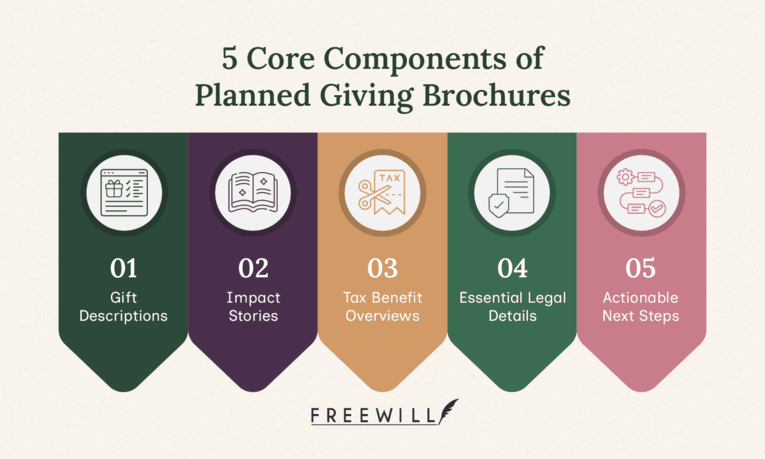
- Simplified descriptions of accepted gifts (e.g., bequests, beneficiary designations, etc.).
- Real-world impact stories to show how other donors have helped your mission.
- Tax benefits of each type of gift and how legacy gifts provide the donor’s family with financial security.
- Essential legal details like your organization’s EIN and full legal name.
- Actionable next steps that donors can take, such as using your online will-writing tool or reaching out to your team.
Be sure to break down the specific steps required to include your organization in a will or trust, so donors know exactly what to discuss with their financial advisors. When designing your digital and physical resources, ensure they also meet accessibility standards so older audiences can easily read and navigate them. For example, use readable fonts and ensure sufficient color contrast between the text and background.
Emphasize the benefits for donors and your cause.
A successful transition from annual giving to planned giving relies on vividly illustrating the mutual value of a legacy commitment. Donors need to see how their generosity provides tangible advantages while also securing the future of a mission they care deeply about.
To effectively communicate this dual impact, highlight the core benefits in your planned giving marketing materials, such as:
- Donor-directed spending. Reassure supporters that legacy donors can determine how their gifts are spent, allowing them to fund the specific initiatives they care about most.
- Tax and financial advantages. Educate your audience about how specific planned gifts can provide financial benefits while protecting their estate. For example, establishing a charitable bequest costs the donor nothing during their lifetime, while potentially reducing the overall estate tax burden for their heirs down the line. Always recommend that donors consult with their financial advisors to understand the exact benefits regarding their specific situation.
- Long-term mission impact. Supporters can retain complete control over their assets and cash flow today while still making a far greater impact on your mission than they ever thought possible. To drive this point home, share stories of how past legacy commitments have sustained your daily work.
Use your annual donation thank-you letters as a springboard to highlight how a legacy gift extends that same meaningful impact into the future. Positioning planned giving as a continuation of their current support bridges the psychological gap between a one-time contribution and a lifelong commitment.
Final thoughts
Transitioning annual donors into legacy supporters is a gradual process built on trust, education, and genuine appreciation. By taking steps to cultivate relationships and make legacy giving a natural part of the donor journey, your nonprofit can secure vital resources for the future. Fostering a supportive, welcoming environment will empower your loyal annual supporters to elevate their commitment and make a lasting impact on your mission.
About the Author

Patrick Schmitt, Co-CEO of FreeWill
Patrick Schmitt and co-CEO Jenny Xia founded FreeWill at Stanford University’s Graduate School of Business in 2016. FreeWill’s charitable giving platform makes it easier for nonprofit fundraising teams to unlock transformational gifts, and to date has generated over $6.6 billion in new gift commitments for thousands of nonprofit organizations. Patrick hosts FreeWill’s popular webinar series, educating thousands of nonprofit fundraising professionals each month about planned and non-cash giving strategies.
Before FreeWill, Patrick was the Head of Innovation at Change.org, where he helped grow the organization to 100 million users in four years. Prior to that, he ran email marketing for President Obama and served as Campaign Director for MoveOn.org.